
It sets the offset, which is how far the face sits behind the shaft, and it sets a big part of the toe hang.
To check toe hang, balance the shaft on one finger just below the grip and let the head settle.
- Face points at the sky: the putter is face balanced. The face resists turning, which fits a straight-back, straight-through stroke.
- Toe dips partway: fits a slight arc.
- Toe points mostly at the ground: the face wants to open and close, which fits a strong arc.
The neck gets you in the ballpark, and the head does the rest. Two putters with the same neck can hang totally differently, so balance the one you're holding.
Plumber's neck
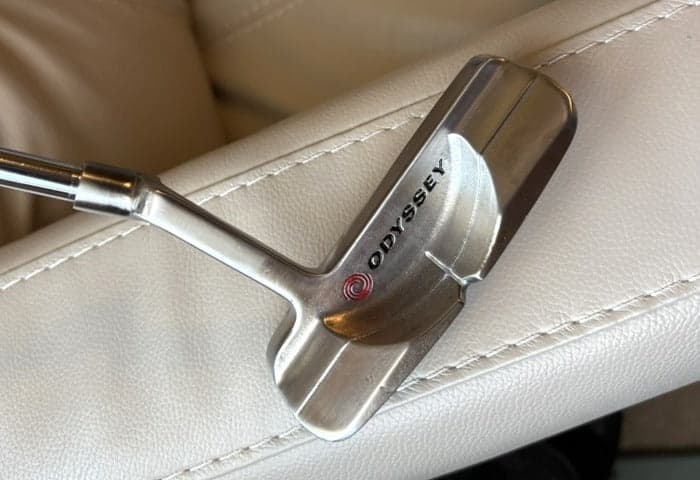
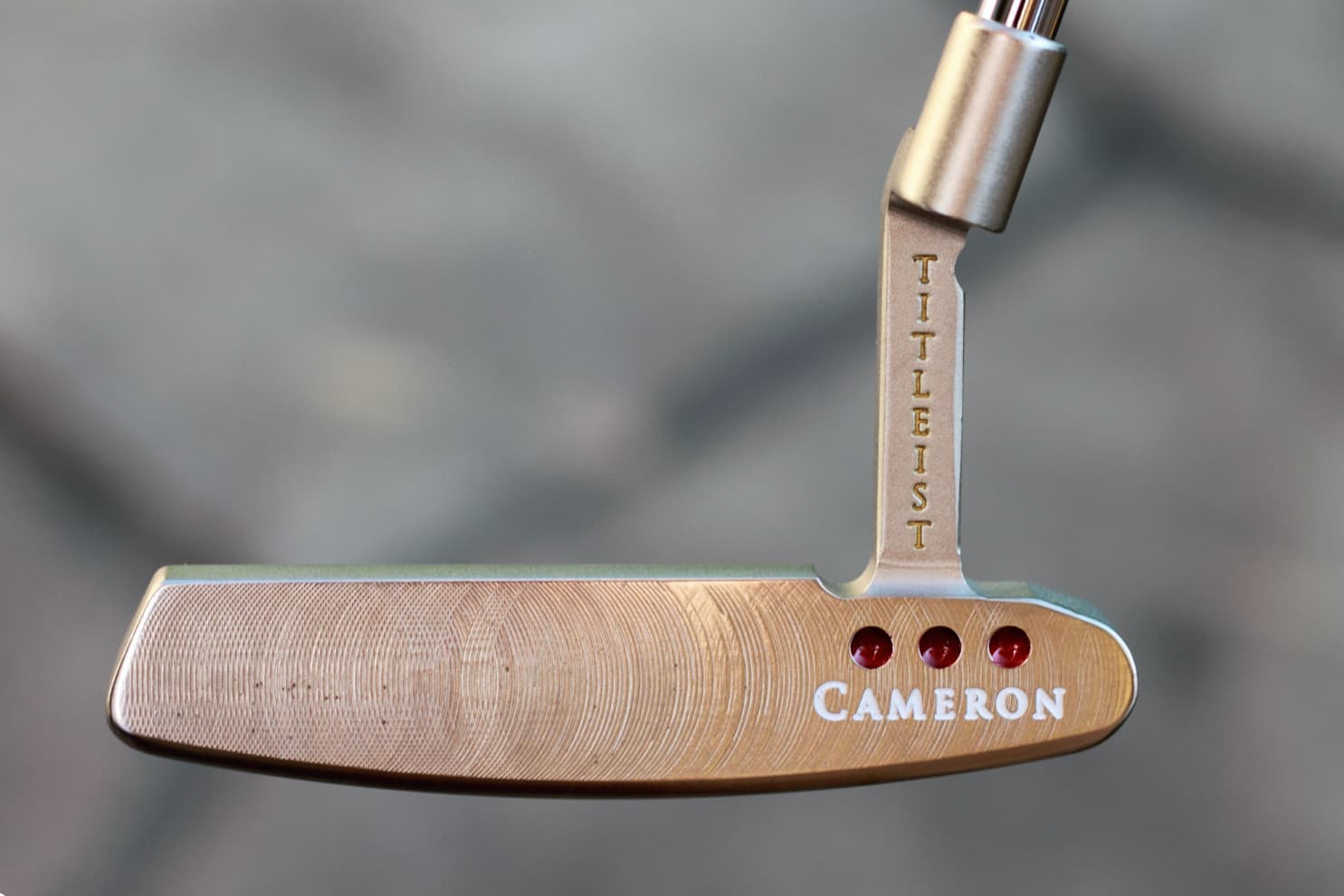
A plumber's neck is a hosel with two sharp bends, like a pipe fitting, that sets the face about a full shaft-width behind the shaft.
This is the neck PING put on the Anser back in 1966, and you'll still find it on more blades than any other neck. Toe hang lands around halfway, which makes it a slight-arc putter.
The Odyssey White Ice #4 in the shop has one. Odyssey calls it a crank neck, its own take on the plumber's neck, with full-shaft offset. See the White Ice #4.
Flow neck
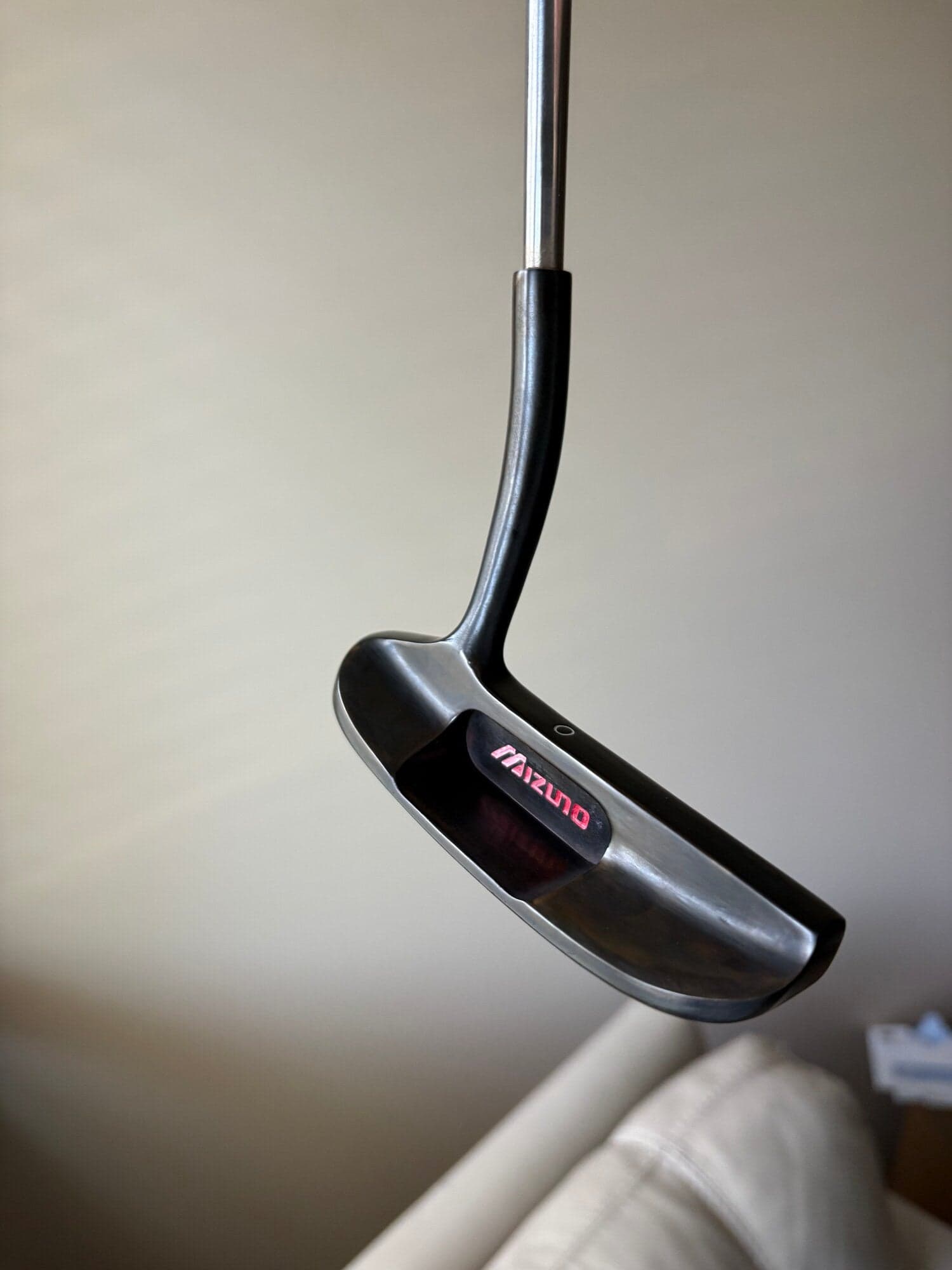
One smooth curve runs from the shaft into the heel. That's a flow neck. Flow necks tend to hang more toe; TaylorMade quotes about 47° on some of its flow-neck models.
Looking down, the heel kind of disappears into that curve. You'll either love that or hate it.
The Mizuno TPM Workshop II I refinished in black oxide, with white and pink fill, has a flow neck. On my bench, this Workshop II hangs more toe than the White Ice #4 above. Head shape and weight matter too. See the Workshop II.
Slant neck
A slant neck is one angled bend from the shaft into the heel, adding offset and toe hang for an arc stroke.
A short slant is the compact version, with only a little toe hang. If you're not sure whether you arc it, a short slant is the safe bet.
Single bend vs double bend
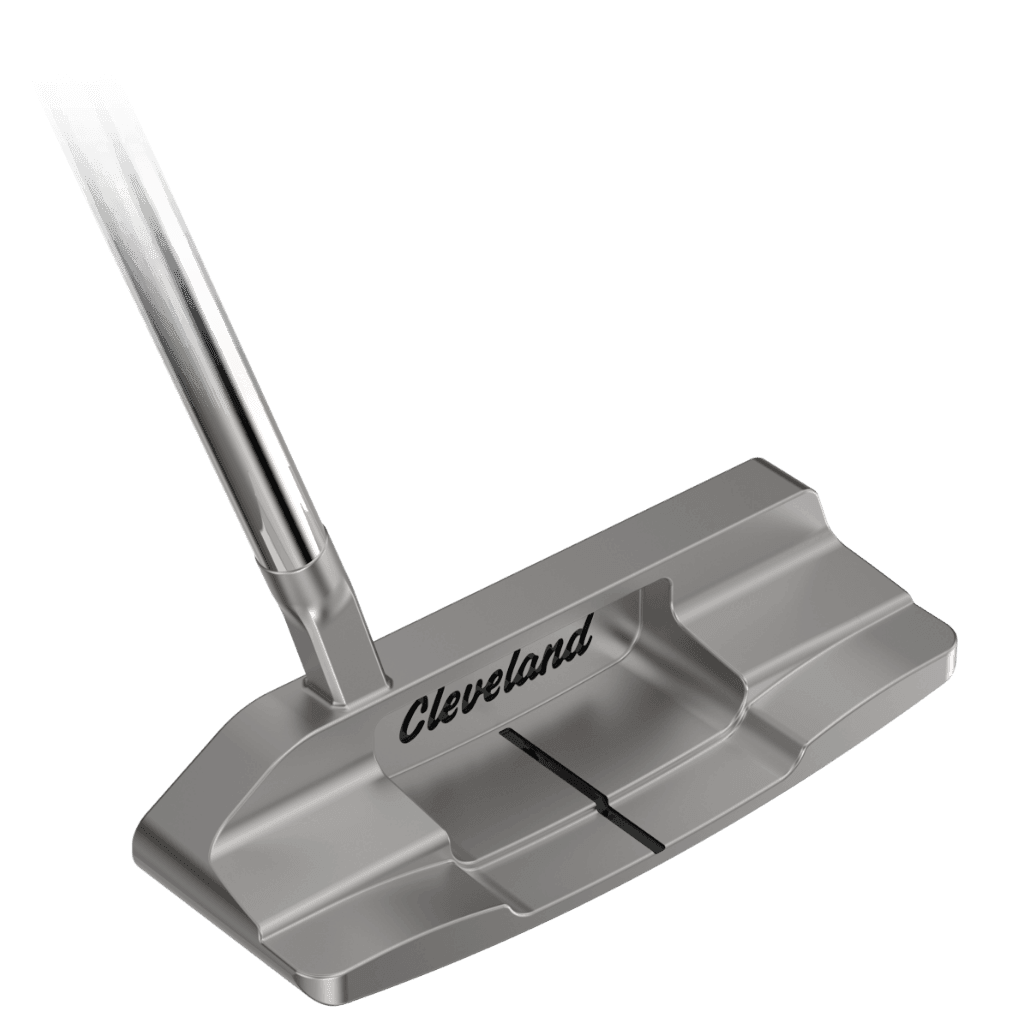
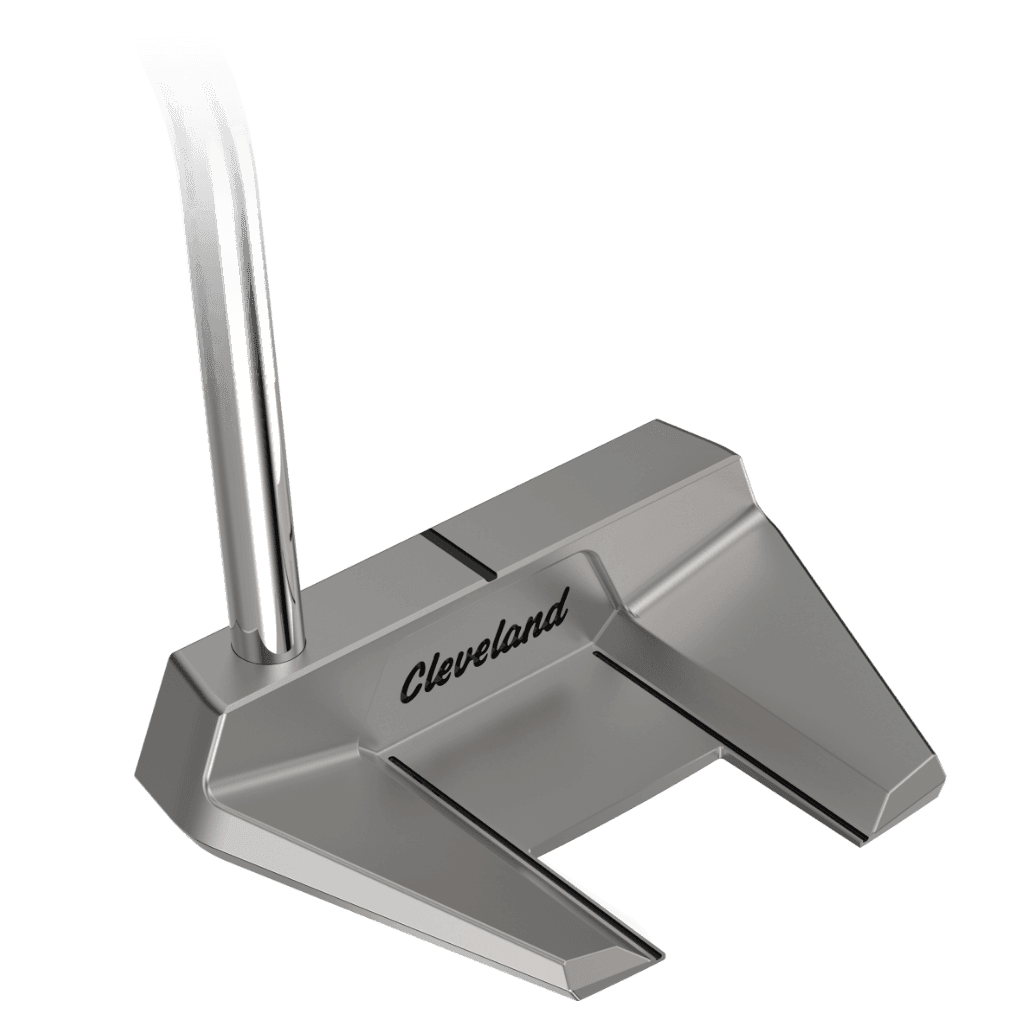
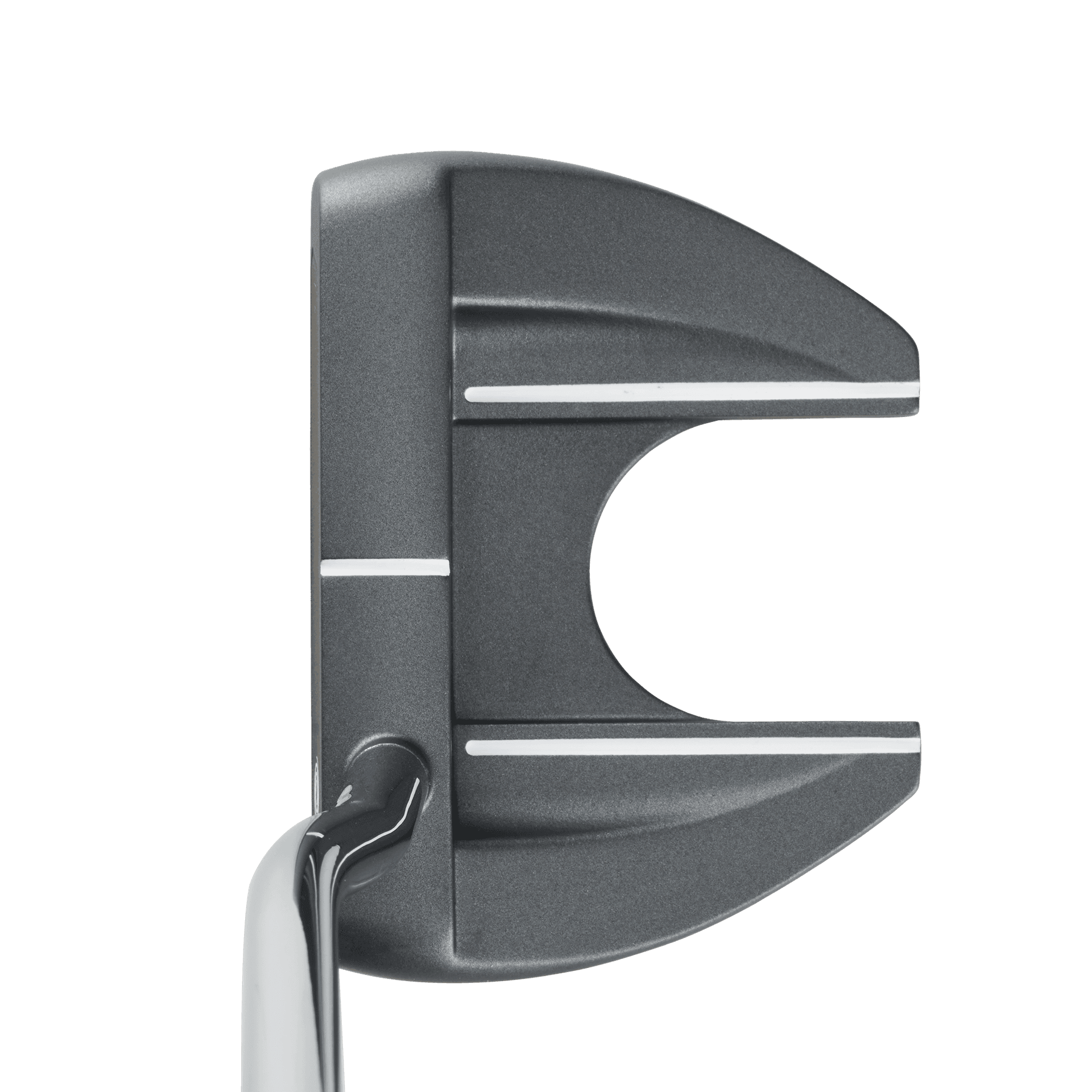
There's no separate neck on either one. The bend is in the shaft itself. A single bend has one bend just above the head, and a double bend has two, in an S-shape. Both are built for a straight-back, straight-through stroke, and you'll mostly see them on mallets. Cleveland's HB Soft 2 Model 11 (single bend) and Odyssey's DFX V-Line Fang DB (double bend, ¾-shaft offset) are both face balanced.
Don't assume a double bend means face balanced, though. Odyssey's Microhinge Double Wide DB is a blade, and it hangs 20°.
Center shaft
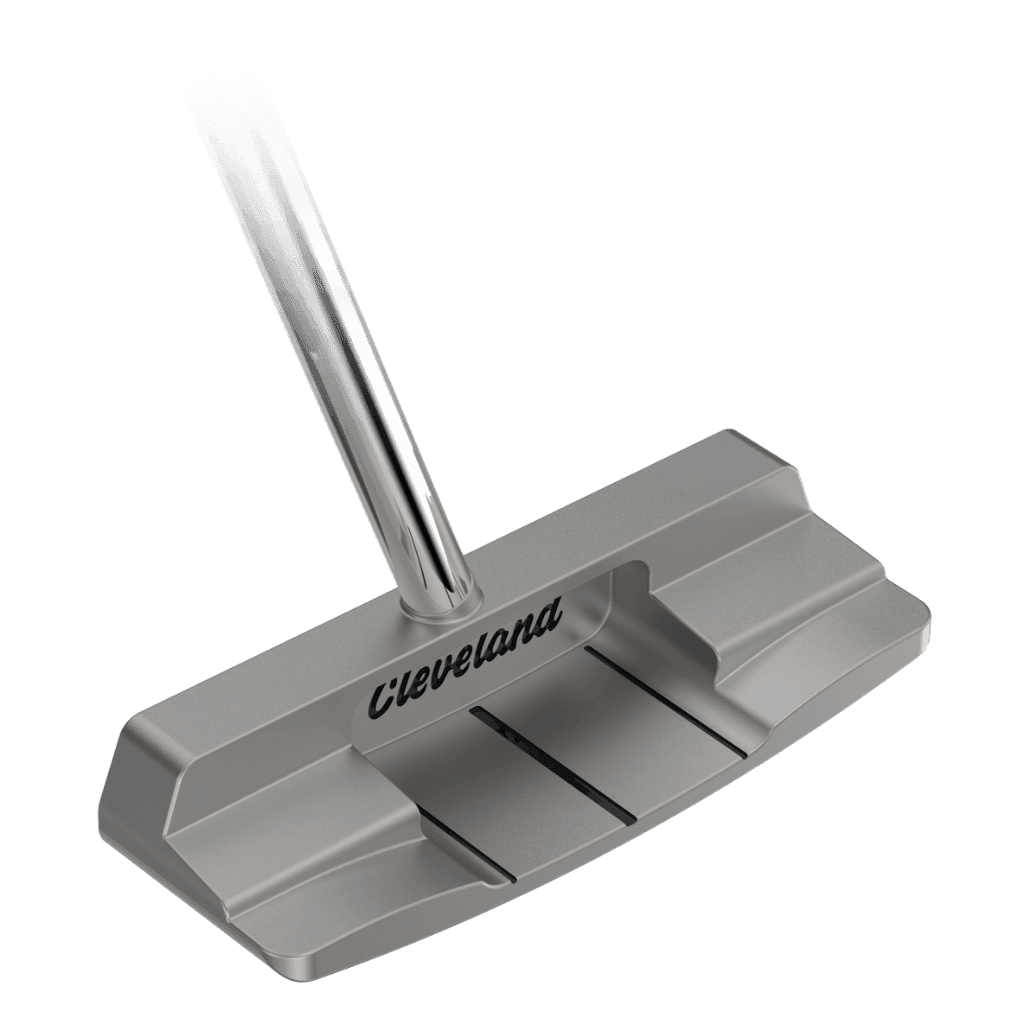
A center-shafted putter has a straight shaft that goes into the middle of the head.
There's little or no offset, and the shaft points right at where you strike the ball. Most center shafts are face balanced, which suits a straight stroke and a "push the shaft down the line" feel.
What else the neck changes
Offset and hand position. Offset sets the shaft ahead of the face, so your hands look ahead of the ball. You'd think that takes loft off. In a 2022 study of 29 right-handed golfers it went the other way: they delivered a big-offset putter with a little more loft. Forward shaft lean is what takes loft off, and that comes from your setup more than the neck.
Look at address. Scotty Cameron's fitters find that players who line their body up off the neck like a plumber's neck. Players who aim off the leading edge want a jet (short slant) or mid-bend neck that gets out of view. Pick the one you trust over the ball.
Aim. Right-handers tend to aim offset putters left and center shafts right. Lefties, flip it. Before you buy, aim a few at a cup from 6 feet and have a buddy check the face with a laser or a chalk line.
Bending for loft and lie. Most steel necks can be bent a little, but how far depends on the putter. Here's what the makers offer: Odyssey says most of its putters bend 2° upright or flat. Scotty Cameron offers the plumbing-neck Newport 2° either way on lie and 1° on loft. PING offers 2° on loft and lie for the double-bend DS72 but only 1° on the center-shaft DS72 C. Hireko's rule of thumb is 2-3°. Zinc heads are die cast and break, and Cameron says a cast neck bent past about 3° will probably snap. Bend before you refinish, because the bar can scuff or crack a finish.
Quick comparison
| Neck | Offset | Toe hang | Fits |
|---|---|---|---|
| Plumber's neck | About a full shaft | Around halfway | Slight arc |
| Flow neck | Large | Often strong | Arc, check the putter |
| Slant neck | Moderate to large | Moderate, more with a steeper slant | Slight to moderate arc |
| Short slant | Small to moderate | Slight | Slight arc or straight |
| Single bend | Varies by model | Face balanced | Straight back, straight through |
| Double bend | Varies by model | Face balanced on most, not all | Straight back, straight through |
| Center shaft | None to minimal | Face balanced on most | Straight back, straight through |
How to use this
Set your phone on the ground a few feet behind the ball, pointed down the target line, and hit a few putts. If the head swings inside the line going back and comes back inside after impact, you've got an arc, so start at the top of the table. If the head tracks the line, start at the bottom. Then pick the neck you like looking down at.
Browse the More Putters shelf, the one-off Refurbished Putters, or everything in the shop. The Cleveland HB Soft 2 blade on the More Putters shelf was bought new this year: see the HB Soft 2.
Putter neck FAQ
- What is a plumber's neck putter?
- A plumber's neck putter has a hosel with two sharp bends that sets the face about a full shaft-width behind the shaft. It hangs around half toe-down and fits a slight-arc stroke.
- Which putter neck is best for an arc stroke?
- Flow necks and steep slant necks tend to hang more toe, so they often fit a strong arc. For a slight arc, a plumber's neck or a moderate slant is the common pick. Balance the actual putter, though. Head design moves toe hang too.
- What's the difference between a single bend and a double bend putter?
- A single bend has one bend in the shaft above the head, and a double bend has two in an S-shape. Both are built for a straight-back, straight-through stroke, and most are face balanced.
- Does the neck change a putter's toe hang?
- Yes, the neck is one of the biggest factors in toe hang, but the head matters too. Two putters with the same neck can balance differently, so check the one you're holding.
- Does putter offset affect aim?
- Yes. Right-handers tend to aim offset putters left and center shafts right. Lefties, flip it. Aim a few at a cup from 6 feet and have a buddy check the face with a laser or a chalk line before you buy.
Sources
Offset, loft and aim: Mackenzie, S.J., Ura, D., Henrikson, E.M. et al., Influence of putter offset on performance, Sports Engineering 25, 15 (2022). "Golfers tended to aim the offset putter to the left as well as deliver the face more closed at impact. Golfers also tended to deliver the offset putter with more loft."
Offset and aim perception: Kevin Sprecher, GOLF.com, What is a putter's offset? And how does it affect your aim?. "The more offset a putter has, the more left it'll make you aim. Less offset, like golfers have with a center-shafted putter, and the more to the right golfers aim."
Neck design and alignment preferences: Scotty Cameron, Choosing the Correct Putter Neck for Your Game.
Bending safe ranges and cast neck limits: Odyssey Golf, 2023 Putter Fitting Guide (2° upright or flat, lie); Scotty Cameron, Newport (2° lie, 1° loft) and Milled in USA ("If you try and bend the neck of a casting more than three degrees you probably end up snapping the neck"); PING, DS72 (2° loft and lie) and DS72 C (1° center shaft); Hireko Golf, Modern Guide to Golf Club Fitting: Putter Fitting (2-3° general rule).